Monday, June 23, 2008

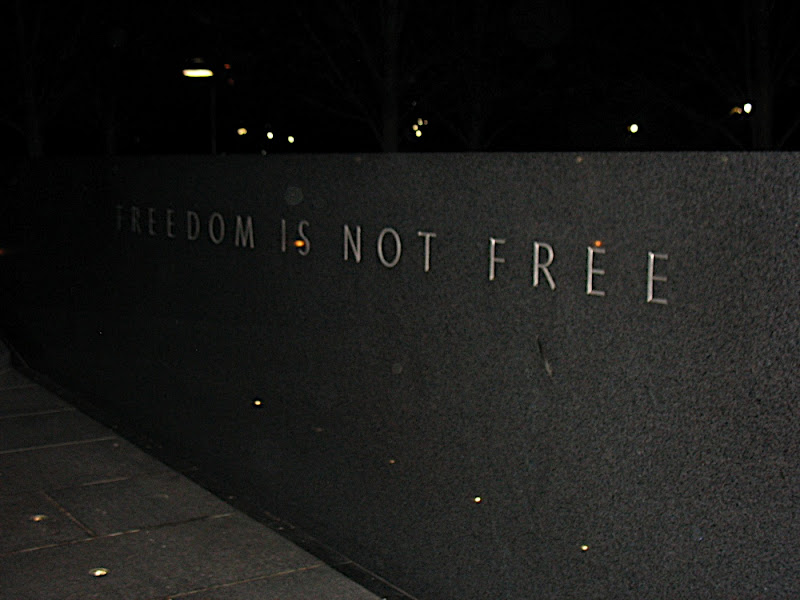
Freedom is Not Free (first time)

I've been looking back through some of last year's writing and marking those posts I want to be able to find again as "memories" in LiveJournal. I found something I wrote in response to a post by one of my summer blogging group. He posted something brief asking for responses. I was the only one who responded and my response was so long that I ended up having to cut it into five responses, one after another.

It was weird to read something I had written, talking about my family and how we reacted to the September 11th attacks, when my father was alive. He died on March 27th of this year, and it was sudden and unexpected. I want to remember what I wrote, so I am copying and pasting it here:

I grew up as the child of immigrant parents who came to this country and became naturalized citizens. I can't tell you they came here to escape poverty or persecution or better basic rights. My parents are both from the UK. While it's true that they did come here and have a good, successful middle-class life, they both probably would have done okay back home too . . but then there would be no ME! (They met over here.)

My son is the child of one immigrant parent (Alec is from Glasgow, Scotland too, like my Mom) and one first-generation American. His big sister, my step-daughter, is an immigrant.

The United Kingdom (from whom we celebrated our independence last week) is also a democratic society, though it's a bit different from ours in many ways. People there do not lack in human rights; in fact, there are more social services available to an extent (think socialized medicine and better public housing in some ways).

However, my parents came HERE, to the United States. And you'll never meet another couple more patriotic than my folks. (I may have blogged some of this elsewhere, but here goes.)

The reason my father came to America was because his older sister had married an American soldier stationed near their home, and she had written home from America about life in the US. My grandparents wanted to see what it was like. So they moved, bringing their two sons with them. My Dad was their youngest. Long story short, after many moves back and forth, my Dad joined the US Air Force and became a naturalized U.S. citizen.

My mother's parents died before she reached adulthood. Her father died when she was three, her sister was two, and her brother was one. My mother remembers her father. She also remembers crying on her first day of school because she thought she would never see her mother again, like she never saw her father again. My mother was about seventeen when her mother died. They went to live with an uncle and his wife (who despised them), and became very close with their younger cousins. They had a pretty poor life, though.

When my mother was old enough, she became legal guardian for her sister and brother. They moved from one condemned apartment building to another, occupying perfectly good apartments until the buildings were scheduled for demolition. (This was apparently not all that uncommon in the Gorbals in Glasgow at the time. There's nothing left of my mother's childhood neighborhood now.) My mother's friend talked her into trying America. They came as au pairs, I guess you could say.

My mother didn't like the first family she was assigned to. Her assignment was changed. That wasn't going so well either. She and her friend ended up living at the YWCA in Passaic, NJ. She was still there, considering a trip back home -- perhaps for good -- when she met my father on a double date.

The other couple never hit it off. My parents are coming up on fifty years of marriage (November 1, 2008).

They vote in every election. They support local organizations, such as the volunteer fire department (of which my brother is a firefighter, and for which my mother is a member of the Ladies' Auxiliary). Mom is active in church groups, local women's groups, and she held an office in the local regional high school board of education. She also worked, for a time, as the Social Security officer for my small hometown. She only has the equivalent of a high school education. She has mostly worked in stores and small restaurants. But my Mom is for sure one of the biggest heroes in my life.

My Dad isn't as active socially or politically, but he drives up to my sister's house, a half hour or so away, every school day, and he takes her three girls to their three different schools, and then he picks them up at the end of each day. He is very friendly with the crossing guard outside the elementary school. He has talked a few other grandparents there through the changes in MediCare. He has taken a fellow kid-picker-upper for a doctor's appointment when she could not get there herself.

During the summer, my Mom and Dad are at my sister's house about three days a week, I would say. They watch the kids and get them to lessons or to the town swimming hole, or out for lunch, or to a friend's house. I sometimes envy my sister for having them so close . . . but then, it was my decision to move to California from New Jersey.

What does this have to do with the 4th of July? Before September 11, 2001, I so often saw Americans, often second- or third- or later generation Americans, completely disregarding the importance of our freedom and of our way of life here. It was only when that was threatened by terrorists that many people began to proudly display American flags instead of just watching on the news as people in faraway lands burned them.


When September 11th happened, I was in bed. I had not turned on the news before leaving for work, so as I drove the eleven miles across San Jose and turned on the radio, I found out for the first time what had happened. A mere eight miles from my parents' home. My brother, the fireman . . . where was he? Would he be sent into Manhattan to help? My parents, my sister, my nieces, were they all right? They go into New York to see shows or for a special dance class, I think. My sister's next-door neighbor was running late and stuck in a cab on her way to a meeting at the World Trade Center.


My sister was in court in Paterson, NJ. From a hallway outside a courtroom, they could see smoke at the Twin Towers. It was not so long ago that there had been a fire there (the first terrorist attempt), so they thought maybe something like that had happened. Later, after entering the courtroom, they were told a plane had hit the WTC. Everyone assumed it was a horrible, tragic accident. A few minutes later, it was announced that the second plane had hit the other tower.

There was that moment, she said, when everyone knew.

Immediately, as this was a county courthouse, they were evacuated. ALL government buildings in the region were similarly cleared of all occupants.

My sister knew people who worked in the Towers. Her daughters' softball coach. My parents and brother knew someone. A fellow volunteer fireman in our hometown. A guy who had graduated from my high school. He was in the Navy, and he died at the Pentagon.

It's amazing, given where I am from, that I didn't personally know more people who died that day in those attacks.

My husband and I had just been back home in August of 2001, for a friend's wedding. The next time I went home, flying into Newark Airport . . . I always used to find the towers, then scan with my eye into the harbor and find Lady Liberty . . . the skyline was left with a gaping emptiness. Of course, I cried as we landed. I had, after all, grown up being able to see the skyline from the street in front of my house.

So I guess what the 4th of July means to me is that we have something in this country so powerful . . . so amazing and brilliant and worthy . . . that people who fear freedom are willing to kill and die over it. To wipe it from our planet. Perhaps they fear that human nature can't handle the freedoms we have.

The first fireworks I saw after the terrorist attacks made me jump and quiver. And not in a good way. I have since gotten over that, and I reflect instead on the Battle of Trenton, which took place in my home state, and which was the turning point in the War for our Independence. (Of course, my family was still British then, so I should say the War for YOUR Independence.)

I reflect on the sacrifices being made every day by American men and women . . . and now the most recent attacks in my OTHER homeland. My mother, husband, and step-daughter are all from Glasgow. I can't tell you the number of times I have gone in and out of that airport. My father is from Northern England, currently a bit of a hotbed of home-grown terrorism in places.

Is all this simply so that I, as an American woman, can be educated? Work outside the home? Have an opinion? Wear what I choose? Show my legs and arms? Those things I take for granted . . . freedoms. They're not free.

Thursday, June 19, 2008

What about the child's RIGHT behind?

Let me start off by saying that I work in a private school. We don't have buckets of money lying around, and my salary is less than that of many public school teachers with less experience than I have.

But what we DO have, that many public schools do not, are quite a few things.

1. Our students typically don't come to school hungry. Their parents have the time, energy, and funding to make sure their kids are dressed properly and appropriately and well-nourished.

2. Our parents are employed, typically in well-paying jobs. In some families, only one parent works, making big bucks while the other stays home to tend house and make sure the kids have all the attention and supervision they require. Some families have two highly-paid parents or two working parents whose combined incomes make the family's life comfortable enough to afford private school tuition.

3. Our parents, for the most part, are involved. They have clearly communicated to their children that education is top priority, and they walk their talk by attending school functions, taking the time to find out what their kids are learning, helping with homework, and maintaining good communication with teachers. Our parents have e-mail, with access at both home and work, so they can reach teachers almost instantly. This is the case in most of our families. Some parents are TOO involved, which leads to other issues, but we've learned to manage that.

4. Because it is a Christian school, although many of our families are not churched or belong to other religions (Buddhism and Hinduism are big ones here), we have the luxury of teaching our students values education in a single, unabashed framework of the Christian faith. That means they get the same message throughout the school, and we, as staff, can back one another up. I know that most teachers impart values to their students, and most schools have a central values framework, but ours comes from outside our school (the Bible) and is one we can all adhere to because of our faith beliefs. We can tell kids that something is wrong because the Bible says so, not because of one teacher's or administrator's personal preference.

(Not everyone has to agree that this is a good thing, but it works well for us in our school.)

5. Most important to me, when I consider what my public school colleagues face, is that we DON'T have to bow down to the Almighty test score. We are not bound by NCLB, API ratings, or the results on our annual standardized tests. Our students do very well on tests, by the way, but I think that has more to do with my above-stated reasons than anything else. As teachers, we can do our jobs without having to worry about all the other things our public school counterparts face every day. That's not to say our kids don't have problems and issues. Theirs just aren't issues of day-to-day survival or safety.

What we've discovered is that test scores don't tell you much more than how that group of kids was doing with that information or skill set on that particular testing day. Teach to the test all you want; we know the kids aren't really learning anything useful (except how to play the system) when we do that. If the government (which is made up of individuals who live in nice areas and/or send their kids to private schools) could be more patient and await results, maybe public schools all over our country would have a better chance of succeeding where it really counts. Kids could work collaboratively on projects that would give them the 21st Century Skills most of our "ruling class" doesn't even know exist.

I am so tired of the hypocrisy inherent in big government, full of wealthy white guys and out-of-touch old folks, telling professional educators how kids learn and how we measure the quality of that learning. Maybe they would see us more as the professionals we are if our salary were commensurate with our responsibilities.

But that's another rant for another day.

Tuesday, June 17, 2008

Skills/attributes necessary for outstanding teachers

Today, Steve Dembo blogged about how people arrive at his blog by searching for an answer to the question “Describe the skills or attributes you believe are necessary to be an outstanding teacher.”

Within today's entry, he linked back to when he initially discovered this phenomenon, and how he felt these potential teachers were only cheating themselves by looking for someone else's answers to use.

From there, you can get back to his "Writing When It Counts" entry from April of 2005, when he first wrestled with the short-essay question himself.

I found the entire process fascinating, and (I admit) I am kind of wondering what Steve wrote in his response to the application question back some three years ago.

I agree totally with his assessment that each teacher needs to write his or her own response, from the heart, and not take what someone else wrote as their own. But, of course, if someone does find something inspiring from another educator, it would be only fair to cite that person's original writing. I know that when my students ask me a question to which I don't know the answer, I tell them, "I don't know that right now, but I know where we can go look to find out." Isn't that really what teaching, and indeed parenting, is all about?

Teaching prepared me immeasurably for becoming a parent. I feel the single most important attribute a teacher can have is respect, and along with that inevitably comes honesty. The funny thing is, these are the qualities by which I try to guide my entire life, not just my career as an educator or the choices I make as a parent. When we respect others, we are, above all, honest with them. We must force ourselves to be humble, even when we know that we're right about something and the other person is wrong. Students know instantly whether or not we have respect for them. But it's also a good idea to have a conversation about respect, what it means, and what it looks like, with each group of students with whom we interact.

Kids also know when we're flying by the seats of our pants. If we make it fun enough -- a sort of adventure we're on together -- they don't seem to mind as much. But if we have enough respect for them to be honest about the fact that we're discovering something together, they will feel that we genuinely care about them enough to admit that . . . "You know what, kids? Adults don't always know everything, and it's better you learn that now before you become one of us and expect too much of yourself too soon!"

Of the adults reading this, I ask: Can you remember a time that, in your role as a responsible adult (teacher, parent, etc.), you simply did not know what to do? I sure can. The key to being grown-up (other than being taller than my four year old son) is knowing that you don't know everything.

So, what if I had to answer that short-essay question right now? (Although I feel I must point out that it's not really a question but rather a command -- imperative sentence.) Would I talk about respect, honesty, and humility? Knowing me, I would probably quote the end of my favorite Robert Frost poem ("The Road Not Taken") and talk about how I have had a mini-poster of that posted in every place in which I have taught since I began my career sixteen years ago. I'm a bit of a weirdo in most settings. I have my summer hair, my funny t-shirts, my tattoo (soon to be tattoos), and I don't wear makeup or dresses. How would this serve to answer the question?

Respect starts with self. How can I respect others if I do not honor and respect myself? If I require respect from those around me, modeling respect in how I treat others, it's a win-win situation, right? I guess I have just learned to try to live by the Golden Rule and not be too hard on myself when I don't get it right. Being an outstanding teacher really comes down to learning who you are as a person, maximizing your ability to teach others using the traits you have always had, and always striving to grow in your ability to be comfortable being yourself for a living.

Almost sounds easy. Ha.

Thursday, January 24, 2008

Cha-ching!

Earlier this school year, I applied on behalf of a group of us for a National Semiconductor Science in Action grant. As a group, we could apply for a $5000 grant. I got our three 5th grade teachers and the 6th grade teacher who covers science and math to be in the group with me. Yesterday, at a staff meeting after school, we found out (quite by surprise) that our proposal was approved to receive a grant!

Our project is like a dream come true for me. I teach computer technology to grades one through eight at a private school here in San Jose. Students come to our class once a week (or twice a week in middle school) to learn computer skills. Last year and this year, since I have come into this particular position, we have really tried to push for true technology integration into the curriculum our classroom teachers are already covering. We have had some success, especially this school year, in meeting their standards while also accomplishing our own goals, which generally involve Microsoft Word, Excel, PowerPoint, and Publisher, in addition to online research skills, e-mail (in grades three through eight), and information literacy (citing sources of information and images). This year we have also been using Google Earth.

Another new addition to this year's program has been geocaching. We've had 4th graders answer questions about California Indians, and we've had 5th graders make decisions on behalf of the main character of the novel Hatchet by Gary Paulsen. This was done through an on-campus geocaching activity during our class time. I'm also going to have a mini-course (like a non-graded elective class) for middle school students during our third trimester. But I have long wanted to combine true scientific investigation, data entry and graphing, and this hobby of mine (that would be the geocaching) into a truly engaging activity for our older elementary and middle school students. Enter the grant project.

What we're going to do is set up real geocache containers, which would be hidden and published on the leading geocaching website, and have them be data collection sites for weather and water quality testing. I'll get some thermometer/hygrometers, mini cloud charts, and notebooks for recording temperature, humidity, cloud cover, and general weather for the 5th grade geocaches. I'll have water testing strips and notebooks in the 6th grade geocaches, which we will hide along creeks in our area. When people find the hidden containers, they will be directed to take readings and record them both in writing in the logbooks, and also on the website when they log their finds. (I am going to have take-away sheets so they can write down their notes to refer to later when they go online.)

We will monitor the geocaches and keep track of the data we collect. I am also really happy I live in the Bay Area, as there is a fantastic geocaching community here, and I know people will be eager to help out by visiting the geocaches and participating in the data collection. I just shared the news with them last night, and I have already gotten some messages with suggestions about possible hide locations and contacts with area volunteers who work with the creek managers and city officials.

Best of all, I know the students will be very enthusiastic to have this real data, gathered in real time, to track and graph (in our technology class, of course) in Excel and Chart Wizard.

I have my sinister ulterior motives too. Maybe kids will find out that the creeks become littered often and they will want to organize creek clean-ups. Maybe they and their family members will discover geocaching as a fun activity to do as a family, and they will learn more about the natural wonders in our own backyards and neighborhood parks. Maybe the kids will become even more environmentally aware and take a proactive role in rescuing our planet from the brink of destruction. I am so sneaky.

This is an exciting development for me and my colleagues. We are excited about how this project will take shape over the coming years. Watch this space for updates . . . almost semi-sorta-regularly.

Tuesday, August 07, 2007

MINDSET: The New Psychology of Success

Mindset: The New Psychology of Success by Carol S. Dweck, Ph. D. arrived Saturday morning (along with Diary of a Spider by Doreen Cronin) from Amazon. I started reading it soon after and finished it Sunday night. That should tell you that it's not a difficult read.

The main premise is the contrast between the fixed mindset and the growth mindset -- not just in students, but in all people. Implications of this in sports, business, and relationships are explored before focusing on education and parenting.

Fixed mindset is the belief that traits such as talent and intelligence occur naturally in some people and not in others. People in the fixed mindset believe that they either "have it" or they don't. And they scorn effort toward improvement, because they think that people with natural talent shouldn't need to work hard. This is why some students who do well all through school with a minimum of effort fall apart later in their academic careers when they suddenly don't get straight-As without studying. The message often comes from parents and the praise they give, telling a child he is so smart or she is so artistic or athletic. The problem occurs when a child has a setback and fears that the parent will no longer think these good things about them. The child, in his or her own mind, suddenly goes from smart to dumb, athletic to clumsy, and so forth.

Growth mindset is the belief that talent, intelligence, and other such traits can be achieved through hard work, and that they are accessible to almost anyone. Certainly, some students may struggle due to handicaps or learning differences, but usually what is required, even for them, is just extraordinary effort. A key finding was that when students could be taught how to move from a fixed mindset to a growth mindset, to learn about how the brain grows inside as it learns, they believed they could get smarter and they were willing to put in the effort necessary to improve their achievement. Often, math scores were used to measure such growth, since mathematical work requires growth and learning in a sequential, step-by-step manner that builds on earlier learning. Another important observation was how people with a growth mindset handle stressful events such as failure, rejection, and even shyness. (There are shy people of both mindsets.) Incidentally, students with a growth mindset steadily improved their math scores while students with a fixed mindset stayed the same or declined.

People with the growth mindset did not fear challenges, because these presented opportunities for growth and learning, which these individuals saw as a good thing. People with the fixed mindset feared challenges, because if they failed at a task, it would expose their (perceived) lack of intelligence or talent. As this is how they defined their value, this could be a crushing experience. This is why you will sometimes see a child who claims to be smarter than others, who brags he or she can do harder things than others, but who refuses to actually make good on these claims. Somewhere along the line, they have internalized the message that their value lies in some fixed ability or trait. And if they fail, they don't have that ability after all!

In sports, there was an illustration of Coach Bobby Knight versus Coach John Wooden, as well as a John McEnroe or Pedro Martinez versus a Michael Jordan or Tiger Woods. The growth mindset coach or athlete does not see it as being all about him (or her . . . case in point, Mia Hamm) but rather about how the team improves as a whole through effort. (Okay, tennis and golf are not team sports, but no athlete truly "makes it" alone; there are always a host of support staff.) In business, Lee Iacocca had a fixed mindset; Lou Gerstner, who turned around IBM, a growth mindset. Examples were also given in the arts. But I am oversimplifying it to give the bigger picture.

What should we, as teachers (and parents), be doing differently? First, we have to analyze our own mindsets, in different areas, including academics, sports, art, and relationships. Do we project this onto our children and students? I always start thinking about myself as a parent. Do I tell Cameron he is a smart little boy because he knows letters, numbers, shapes, etc.? What I need to learn how to praise is how hard he worked to learn all these things. Conversely, would we belittle an infant because she can't talk? No, because she simply has not learned how yet. So, in many different areas, can we re-learn how to send messages to our children about their own worth and value? Can I start talking to my son about his effort and achievement rather than the gifts I suspect he possesses?

When we lead our students at school, can we re-train their mindsets, in many cases against what their parents have taught them, to value growth through hard work (even if it means learning from some mistakes and failures)? This is a tough one for me, because so many of my students live in a situation where failure of any kind is intolerable. Often, when a student gets a B or lower, parents will come in demanding to know what the teacher did wrong. The idea is that their child possesses such infallible talent or intelligence that missing an A grade must mean that the teacher tricked the child or did not do her job. The danger inherent in this arises later in life, when a friendship or other relationship falls apart, or a job opportunity is not won because someone else was better qualified. Or, more immediately, the high school or college of choice does not accept the student, regardless of grades and other rated achievements. The child, encouraged by their parents' limited view (fixed mindset), labels him- or herself as a nothing. "If I couldn't get into (insert name of school here), then I never was smart or talented or gifted or ANYTHING."

Imagine, now, the power of teaching these same kids the value of hard work as the means to achieve anything they desire. That means that opportunities can be achieved by anyone, not just a chosen few. Some will have to work harder than others, but they will have exercised and grown their brains more, thus becoming more intelligent. And then, when a friendship fizzles, when a marriage falls apart, when a test comes back with a D grade, or when the team loses, these are opportunities to learn how not to repeat the same mistakes. (NOT a reflection of a person's individual worth or value.)

See why I recommend this book?

Thursday, July 19, 2007

What IS blogging? I mean . . . really?

As you may know, I have been blogging for a while. This is the third consecutive summer in which I was actually paid to blog, and this is my second summer of having it be my full-time employment. I think, in all this time of watching bloggers who are also teachers, I have come to a decision about blogging and education.


Would you like to know what that decision is?

Much of the time, in many cases and situations, it's just not worth it. A waste of time.

However, it CAN be done well. And it can get kids motivated to work harder and better than they would without it. But there are so many things to consider:

  • What if it takes your students SO long to type what they want to say that they end up frustrated and they give up? Do you have the time to devote to their being trained in keyboarding skills? Do they suddenly become aware of spelling and grammar errors they've been making all along in writing, yet are ill-equipped to deal with them?

  • What if you get a whole big ol' blogging project all planned out, and then the first day you take your kids to the lab, there is a power failure? Or, worse yet, everything is working fine, but your top three choices of blog clients are blocked in your school/district?

  • What if you end up taking more time teaching people how to blog than you can afford? What if they never truly learn the ins and outs and you have neither a product created nor a standard met? How's your principal gonna like that?

  • What if everything works fine, is not blocked, and your kids learn how to use their blogs quickly? What if they become pros and figure out features you never intended them to use, mainly because you did not know they existed? What if you get called in to see your principal because your students are staging an online revolt against you and/or the school and you never even knew about it?

  • What if the precious darlings you have blogging end up either filling their blogs with profanity (which you will get to find and address) or nothing at all because all the posts they attempt get blocked by the content filters?

  • What if you assign a blogging homework assignment, only to be hit with a plethora of excuses (some of them genuine) about why half the class can't blog anywhere but the school's computers?


There are plenty more "what-ifs," but I think you get the picture. A part of me is convinced that there are only ever really twelve to fifteen different conversations taking place on the Internet at any given time, and they just keep getting brought back up with different window dressing. Some of these include:

  • What I did at (school/work) today

  • What I did this weekend instead of my (homework/housework/chores)

  • Stuff and/or people I totally love

  • Stuff and/or people I totally despise

  • Who should win this round of American Idol and why

  • Why you believe (or don't believe) in something

  • Here's a link to something I found (interesting/funny/disturbing/a little too close to home)

  • What I want to do when I (grow up/grow old/graduate/retire/get married/get divorced/have kids/empty my nest)

  • What I want to do before I (grow up/grow old/graduate/retire/get married/get divorced/have kids/empty my nest/die)

  • A list of my favorite Your Mama Jokes (or similar fluff)

  • Political ranting and/or commentary on current events

  • Surveys and other Memes


Go ahead; prove me wrong. I want you to. Really.

Monday, June 25, 2007

A letter I will never send

I was skimming through one of the featured communities this evening (dear_you) and found the concept rather interesting. To whom would I write such a letter? My ex-husband? My friend Billy who died at age 38 in 1995? My former students? A teacher from my past? Maybe. Maybe not.

I know.

My son.

Dear Cameron,

We wanted you so much. We had to pay a lot of money to make you happen. The first time I thought I was going to have a baby, I was wrong. That was so disappointing. But then, just a month later, it turned out to be positive news! All that time, I thought about you constantly. What did you look like? Would you like the same things I like? What would your voice sound like? When would you understand that I was your Mommy and that Daddy was your Daddy?

And then . . . we weren't even ready yet! You came so soon. I had only just finished up at work, had only just written a letter to my fifth graders on the board, telling them to be good for the sub. And I started to feel really uncomfortable. Early the next morning, after a long night of trying to get you to come out the regular way, they told me I would need an operation. Less than two hours later, I got a brief glimpse of you before they whisked you off to a special room to make sure you were okay. You were three and a half weeks early, after all. They made Daddy sit in a wheelchair and rolled him out of where we first met you. He followed you down to the special room. It was a long time before I got to see you again.

That night, the nurse brought a wheelchair for me. I was still wondering what you looked like. I was still trying to imagine how big you might be. Or how small. It hurt more than anything I have ever felt to get out of the bed and into that wheelchair. The nurse tried to talk me out of it, to get me to go back into the bed. I looked at her and yelled, with tears in my eyes, "It's been eight hours since I had him, and I haven't even held my son!" The next thing I knew, I was being wheeled down the hall to where you lay waiting. Were you waiting?

When I saw you, it took my breath away. You were small. And there were all these tubes and wires and machines. You were in a kind of dome thing. Four or five different machines were making noises telling the doctors about your breathing, your heart, your pulse. Every twitch another beep. Sometimes you forgot to breathe. I was so scared. I was even afraid to move you or touch you. They carefully moved enough things out of the way so that you could come out from under your dome. I didn't even know how to hold a baby. They handed you over to me. I sat in the rocker and looked at you. Machines beeped, and sometimes their alarms sounded. Sometimes it was not a big deal. Sometimes I had to rub you and tell you to breathe. It was only later that I would notice the other babies in there. Most of them were even smaller and earlier than you were. A nurse used Daddy's camera to take pictures of us with you. Daddy took some more of you in your little bed in the hospital. Now, when you see them in your little picture book, you tell me, "He's inna hop-sit-al. He gonna go home soon."

It wasn't soon enough. It was five days before they let me out. Eight days for you. Those were such long days. Every day, we had new hopes that you could come home. Every night we had to leave you there and come home without you. I woke up and cried at night. I called the hospital and asked about you. And I was always there in the morning to come hold you and feed you. Finally, you came home. You were still so tiny. Mr. Wes next door saw us driving home and he came by with flowers later. He was the first person to see you at home, other than Daddy and me. He said you were beautiful and amazing. He was right.

The rest is a blur. Daddy got up with you every night. He wanted me to rest, because I had to have another operation two weeks after the first one, and a week in between those I had to go to the hospital every day to see the doctor. It took me a long time to heal from the operation, but I have never regretted a thing. My scar reminds me of you. Every stitch and staple was worth it.

Now, when I look at you . . . when I talk to you, and you respond back . . . when I hold your hand as we walk around the neighborhood . . . I can't believe how amazing you are. I used to wonder what it would be like to have you hold my hand as we walked. Now, you won't let it go. And sometimes you climb up my leg and I have to pick you up when a doggy comes along. I used to wonder what your voice would sound like saying "Mommy." Now I wonder what it would sound like NOT saying "no!"

I still wonder about some things. I wonder if you will like school. I wonder if you will make friends with other kids. I wonder if I will someday have to deal with you NOT wanting hugs and kisses from your Mommy. In the meantime, I give you them every chance I get.

And when I get upset because you won't help clean up your toys . . . or when I lose my temper and get angry when you make a mess because you won't use your potty . . . I remember that helpless little baby with all the tubes and wires and machines hooked up to him. I remember praying to God that you would be all right. I remember crying as I hung up the phone after the nurses told me you were fine, but you still weren't home with me. I remember being so grateful that despite a few early setbacks, you were perfectly healthy, fine, normal, amazing, beautiful. And I remember when you were still inside my tummy, moving around a LOT when I would lie down in bed at night and wonder what you looked like. And now I can just go into your room and look at you as you sleep.

And thank God that you ARE all right.

Good night, baby.

Love,
Mommy

Tuesday, June 19, 2007

Final Reflection for Google Certified Teacher requirements

Diane Main, Computer Technology Lead Teacher
Milpitas Christian School
3435 Birchwood Lane
San Jose, California 95132
dianemain at gmail dot com

I offered a series of three courses, spread out over three months. Each was held on a Wednesday after school, for two hours per session. Teachers who attended all six hours were able to earn a CEU for free. About eighteen educators signed up, including two from our school’s preschool and three or four from another private Christian school several cities away. (Kings Academy in Sunnyvale) As it turned out, the people from our preschool and all but one of the people from Kings had to cancel due to other commitments. There were 13, 11, and 10 people in attendance at the three sessions, respectively. The sessions were Google Earth (January 24), Google Tools and Information Literacy (February 28), and Google Docs & Spreadsheets (March 21).

In the Google Earth session, I talked about what Google Earth is, and I demonstrated the program on the large screen via projector hooked to my laptop. Several attendees had brought their laptops and installed the program while we held the discussion. We brainstormed how teachers thought they could use Google Earth for their classes and with their students. I had downloaded several files from the Keyhole BBS in advance of the class, and the teachers enjoyed seeing how others had already created Google Earth activities. Some were created by teachers and some by students. I shared Google LitTrips and Postcards from the Past, both created by fellow Google Certified Teachers I had met at the Google Teacher Academy only a few months earlier. One fourth grade teacher, who had a student moving back to China two days later, spent some time the day after this session “flying over” the Earth from San Jose to this child’s village in China, showing the kids in her class where their classmate would be traveling the following day. The teacher showed an enthusiasm I had never seen in her before, and I was impressed with her willingness to dive right in with Google Earth.

In the Google Tools and Information Literacy session, we logged in to the PCs in my lab and I had each participant select a tool from “Even More” just to experiment with. As teachers began looking over one another’s shoulders, some found tools they planned to start using, either personally or professionally. But the excitement really started when we began to discuss the concept of information literacy. My co-teacher and I shared our experiences so far that year with having our students use Citation Machine to cite their sources of information. I also showed a short movie I had made for teaching my students how to cite sources of both information and images. Some of the teachers were relieved to know that we were helping kids understand why we cite sources and how to do it correctly. One of the teachers brought up Wikipedia and asked for my opinion about this well-known and much-maligned online resource. The conversation caused some participants to consider things they had never even thought about before, and I think it turned out to be a very good session, even though it veered strongly from my original plan. I think one thing that surprised a lot of people is when I told them we had found several errors in our Encarta CD-ROM Encyclopedia, and that other sources along with Wikipedia were correct and helped us to verify our information.

In the Google Docs & Spreadsheets session, it took no time at all to get the attendees hooked on collaborating. I had made sure each participant had been invited to gmail in advance of this final session, and that each one had set up their account so I could invite them all to collaborate on a document right before their eyes. Again, they logged in on lab computers, though some worked from their laptops instead, and we created a very silly document together. One teacher got the idea to have some of her sharper students begin collaborating on writing articles for the school’s newsletter, which gets sent home with all the students in our entire school. We had a great discussion about how teachers could use D&S with their students and we tentatively formulated a plan for getting kids set up with Google accounts next year. (I have since discovered that there is now a way to tie in Google Apps For Your Domain with Gaggle.net accounts, which our school has in grades three through eight, so I am pursuing that this summer.) In demonstrating the Spreadsheets section (before they added charting capability), I exported a spreadsheet from Google D&S into Excel and then used Chart Wizard to graph the data. This got the fourth grade teachers especially excited, as they had science projects coming up. This gave me a chance to show off the project their students were working on at that time, which involved graphing data about an assigned state (population change through history, ten most populated cities, and percentages of ethnic groups). The unexpected benefit here was that I suddenly got extreme buy-in for integration projects with these teachers, who had been reluctant before because they thought it would be more work and too hard to make happen, I think. By the end of the school year, we had a lot more participation by those teachers in signing up to bring their students to the open lab, AND we changed our curriculum to enable their students to complete several tasks related to the science project . . . including graphing their data in many cases . . . in our class when they came to us. This was done in Excel, but I would like to see it done with Google D&S in the future.

Most of the educators in attendance were very excited about the possibilities these tools presented. After each session, several teachers experimented with the tools and some began using them with their students, as I have already mentioned. We are also looking forward to expanding our use of these tools in our lab classes to support teacher use of the tools and to encourage more collaborative work by students.

Two challenges I faced in presenting these sessions were as follows. One or two attendees were seriously behind the rest in basic computing skills, and it meant that the entire session could sometimes get held up over a minor technical glitch that had to be overcome here or there. The person visiting us from another school was an art teacher, and while she felt she got a lot out of the sessions, I felt I could not tailor my presentation to meet her needs enough. When discussions were specific to what we do at our school, she kept herself very busy exploring Google Images, which she had not used much before that time, so at least she got something out of it.

I think my own personal growth was impacted in several ways. First, I had been struggling all year up to this point to really connect with certain teachers and to encourage better communication regarding technology integration between their classrooms and the computer lab classes I teach. Once we took the time to hypothetically discuss the uses for some of these tools, a lot of things became clearer as to how we could collaborate better on projects the kids could do to meet both our technology standards and the state’s curriculum content standards. In addition, I got more practice presenting to groups, and since a lot of things came up that I had not anticipated, I got the chance to both improve my “thinking on my feet” skills and to share my passion for technology in education. I think my enthusiasm alone during these workshops helped bridge some gaps that had been gaping a bit too widely before this point.

As for the future, my plan is to investigate the tie-in with Google Apps For Your Domain and Gaggle.net and make full use of these in my classes next year. I already anticipate a better success rate with technology integration projects, as the administration at my school has promised to be stronger in encouraging classroom teachers to fully take advantage of what we’re trying to accomplish in our lab. I hope to reach more educators in the coming year by having some of the teachers from my school co-present with me, perhaps having their students present their own work as well, in an effort to not only share what we do but to also encourage other teachers to want to learn more about the applications I shared this past winter.

Sunday, February 04, 2007

Web 2.0 (and away we go!)

My colleague in cyberspace (and California), Kyle B., sent me a link to his blog entry about this video you really need to watch if you want to begin to understand what Web 2.0 is all about. And if you have not heard of Web 2.0, please stop reading this blog, go watch the video, and read Kyle's blog post about it.


Why are you still here? GO!

Wednesday, January 31, 2007

I'm bringin' GEEKY back . . . .

The title is a reference to a song I could not stop dancing to today. Okay, I stopped when the kids got to the lab, but we only had three classes today, so I danced a little too.

Working on quite a few videos at this current time . . . there's the ESLRs video for our school's accreditation visit, the video for next week's chapel, and one for some friends of mine. My next big education one for use with my students is going to be a tutorial on using the San Jose City Library and Santa Clara County Library websites to find a book, video, or even a magazine article from the comfort of one's own home, even in one's pajamas.

Squeezed a few cache finds in at lunchtime, then we had a bunch of first graders come in at two to finish up and print their acrostic poems. We've had a lot of our younger kids out sick lately.

I'm really excited about what our students are working on lately. First and second graders are using PowerPoint to write and illustrate math problems. First, we did multiple addition (first graders are still on that project). Then, it's on to word problems (addition and subtraction). Our upper elementary students are making BioCards, about a Native American group, a famous Californian, or a figure from Colonial America. (3rd, 4th, 5th, respectively) Our 6th and 7th grade students are finishing up Poetry Portfolios while the 8th graders wrap up their Washington D.C. PowerPoints (to help them present their research papers to their history classes). The portfolios consist of poetry on a particular theme, both found poems by other authors and poetry by the students themselves. They are also putting in artwork to round out the portfolios.

Next we move on to using spreadsheets (again), but this time for budget and home economics type stuff. (Not cooking and sewing, but shopping and carefully spending!)

The most exciting thing is that our students are very motivated, and they are really impressing us with their performance and maturity. They've come a long way from the start of the school year. They understand what we expect, and they are delivering. It's the start of the revolution I had been hoping to put in place. These guys are not quite ready for being true contributors to Web 2.0 yet, as they lack some of the self-control to stay focused and serious, but we're getting there.

Baby steps, grasshopper. Or would that be baby hops?

Tuesday, January 30, 2007

In defense of Wikipedia . . .

Last week, I was working with a group of teachers, showing them Google Earth and talking about some ways it can be used in education. Some of the overlay files I was using included location spotlights with links to wikipedia articles. So, of course, the topic was raised, "Diane, what do you think of having students use wikipedia as a source?" This was a fifth grade teacher who asked, and a colleague of mine for some time. Also, during the time I taught fifth grade (five years), she and I were both teaching fifth grade for the last of those five years.

Let me first say that there are times I don't let my students use wikipedia as a source. Sometimes it's because I am not allowing web sources on a particular project, and sometimes it's because I want them to broaden their searches. But I am not completely opposed to its use. I do warn my students, though, that just like everything else on the Internet, it must be evaluated for accuracy.

But so must the more traditional sources. Ready for a case in point?

Yesterday, one of our fifth grade students faced a dilemma about her topic, Molly Pitcher.

Now, Ms. Pitcher's real name was Mary Hays. The student's book source said that Mary's husband was William Hays. Encarta 2001 on CD-ROM said that Mary's husband was John Hays. Two "trusted" sources with two conflicting "facts." What to do?

I happen to keep a full set of the 1991 (gasp!) World Book encyclopedia in our lab. I gave the student P for Pitcher and H for Hays and told her to start in the P volume and see what she could find. Then I logged on to the available computer next to her and went to see what wikipedia had to say on the matter.

Here's the verdict:
Book: William
Encarta: John
World Book: William
Wikipedia: William

WHAT? You mean Encarta was wrong and wikipedia was right?

Of course. Both had to be typed in at some point by human hands, and humans are prone to error, whether their work is published by a software giant onto CD-ROMs or constantly updated by caring scholars and lay people on the Internet. In fact, the CD-ROM version of the "truth" cannot be changed. You have to buy a newer disc to get updated information. (And it would be interesting to look into whether Encarta has changed this error in later versions.) Wikipedia is constantly being reviewed by many different sets of eyes, along with their corresponding brains and hands. So errors can be caught and made right.

So, what did I tell my students? If you ever get conflicting information when you are doing research, get two more sources to help you figure out what the real truth is. Beware of bias and deliberately misleading information. And don't believe everything you read.

Nothing new there.

Thursday, January 18, 2007

Turbo-caching

It's not really something I should be proud of, but the very first geocache I ever placed disappeared within 48 hours of its being published (made official) on the geocaching.com website. I am so bummed, but I kind of saw it coming. I guess I should be glad that my neighbors are so aware of what's going on in the park across the street from their houses. And I think my next-door neighbor is probably the person who removed my little cache from its hiding spot. I'm just too embarrassed to ask for it back. And there's no way for him to find out it was me unless he becomes a geocacher himself. I guess I'll never see it again. [sigh]

In other news, I am up to 92 finds as of today. In a little over two months. Yes, I am proud of that. I am presenting the first of my three Google workshops for school staff next Wednesday (Google Earth for this session). I really need to sit down and prepare. I also need to work on the movie I am making for my friends' daughter's sixteenth birthday party. And the thank you cards I need to hand out for all the Christmas gifts I received from students. And the stack of grading I still need to get done. And more.

It's not easy being geek.

Saturday, January 13, 2007

Lights, Camera, . . . .

GEEK!

Yes, I've been making movies again. I needed to make one for work, to make part of my job easier. It's about citing sources of information and images properly, and you can view it here. (It's the only .mov file there at this time.)

Then, of course, I had to do a cute one.

Hope you like them!

Wednesday, January 10, 2007

I can't believe it!

Only a little over a month later, I JUST found out that my birthday coincides with Ninja Day! Please go and view the video. I want celebrations next year.

Monday, January 08, 2007

Speaking of being stuck in the past . . .

Schools, that is. Time Magazine ran an article about this very thing. I'm reading it right now. And now you should go do the same.

Let's chat about it later, shall we?

Sunday, January 07, 2007

The State of Education: A Neighborhood Discussion

Okay, so I subscribe to a neighborhood eList for my part of San Jose. There had been quite a lot of discussion and debate over Proposition 13 and its outcomes. I had been skimming much of it, but I did not contribute. Finally, a few people started an offshoot thread dealing with the matter of "what's wrong with education today." Being a teacher (and a darn good one at that), I felt it was my duty to step forward with my feelings on the subject.

My initial post:
Schools, past present future
T. commented, quite correctly, that a major problem with schools today is lack of parental involvement, mainly due to work demands and lack of English expertise.

Then K. rebutted that these have always been problems for parents of school kids. Also true.

A major difference, though, (and I say this at the risk of sounding like an old fogey) is what the kids are doing while their parents are working, and how time is spent, and general parental attitude and expectation toward education and the school experience.

In the past, parents made it clear, both by word and deed (kids could look at their living example) that education had value, teachers deserved respect, and a diploma and a degree were the ticket to success.

Now, it's not only that parents may not be involved. (They certainly don't fill up parent-teacher association meetings, myself included on the parent end. And I'm a teacher.) It's that education is not necessarily a guarantee of career or financial success. (Look at all the people who got rich in the dot-com boom of the 90s with less educational experience than I have as a poor, underpaid teacher.) AND there is no respect for schools, teachers as professionals (just look at our salaries), or any kind of authority or institution. It's more of "no school/teacher/principal is gonna tell me . . . " and less of kids getting in worse trouble at home after a reprimand from school. Remember when you dreaded the note home? Now, kids come to school, backed by vociferous parents, ready to do battle and excuse their way out of any kind of consequence.

This is certainly not true of all parents. But it's no surprise, when you look at our media influences, that kids will threaten to try to get a teacher in trouble rather than admit being wrong and accept consequences. Today we hear kids say things like, "I'll just say a teacher molested me" when they want to avoid getting in trouble for their actions. And now we have many more single-parent families than in the past. How is one adult, in today's high-speed high-tech culture, supposed to do the work of both parents, when more is expected of the parent from work (at perhaps several jobs to keep up with the high cost of living)? Even two parents -- in our area here they're both working full-time -- struggle to keep up.

Gone are the days of Wally and the Beav, when Mom was always home to make three square meals, help with homework, do all the housework, AND bake cookies for the class party. Not that those days are preferable; I work full-time, and I am a wife and mother. HOWEVER, society has changed. Heck, EVERYTHING has changed.

Except education.

We still expect to do things the way we always have and get new and better results. Kids do not attend school in a vacuum. School staff frequently deal with neglected, hungry, improperly dressed kids day in and day out. But you better not give a kid an aspirin or even a hug.

Even when schools appear to be different nowadays, due to new technology or different methodology, any teacher who's been at this game a while can tell you about the pendulum swinging back and forth every few years on any number of issues in education. And all the computers in the world aren't going to change a thing when you have a system (and parents) who demand the A-B-C-D-F manner of grading, tests with pencil and paper, and all kinds of old standbys of yesteryear's schools.

I'm not saying any one thing is bad or good, or that any one method is preferable over another. What I am saying is that the world has changed. The same problems may exist, such as the parental language barrier and overworked parents, but they are so much more magnified in today's school climate. You're not going to tell me kids haven't changed. They know more by the age of ten than most of us adults knew by the time we finished high school. Not curriculum, such as grammar, math, science, or history -- although they have more information at earlier ages than they used to, since information is so readily accessible -- but they are much more worldly wise and have experienced so much more . . . often not for the better.

Education . . . and especially the funding thereof . . . is an incredibly intricate and complicated issue. No one statement can accurately sum up its problems or their solutions. And blindly throwing money at those problems is certainly not the solution.

I have had my rant for the new year. Stepping down now . . . .

Diane


I just figured I would get a few brief comments on the public forum. Not so. But I did hear from some people . . . . . .

From J.S. –
Lots of good points, Diane.

I know my parents were that way. They were poorly educated but fierce in their support of teachers, administrators and education in general. If we kids had a complaint, my parents' attitude was, "Live with it."

In reality, the quality of our teachers had a normal distribution: A few were great, most were adequate, and a few were terrible.

My folks insisted that we kids take responsibility for our learning. They couldn't help us with homework; they weren't educated enough. But, we were expected to do it, to try our best, and to get good grades. And if we didn't, it was our fault, not the teacher's.

They believed that we kids had to learn how to function well with any quality of instruction. As they said, "When you're an adult, you're not always going to have the perfect job or the perfect supervisor, so you'd better learn now how to overcome these kinds of obstacles because you're going to have to face them all of your life." And they were right.


From T. –
Very, very, very well said! :)

From K.S. –
Diane-
I think you have really captured the essence of the whole education system problems. Everything has changed and the system has not even come close to adapting.

Having several good friends who are teachers and a mother who decided it was time to retire for the reasons you listed (not because she ever stopped loving teaching kids) I just wanted to let you know I appreciate your frustration as a teacher and a working parent. I often wonder what it is going to take to engage the public in helping make the changes.
Hang in there,


From A.W. –
Hi Diane,

I am going to reply off-list because I don't want to get attacked by the rabid eListers.

I totally agree with you that everything has changed except education. I'm not advocating some drastic, immediate change (which just ends up being the current fad) but I think we need to start moving in some new directions.

One thing I believe (and feel free to disagree!) is that we have to let go of this notion that parent involvement is ever going to be a big part of kids' success in school. I see lots of "involved" parents who seem mostly interested in fundraising or social activities at their kids' school. But, as long as their kids' grades stay up, they have no clue what the kids are doing with their free time (and their cars and cell phones and spending money and internet access). Others have no idea that their child is struggling in some way until they drop out of college in their first semester (one who spent twelve years at Harker!).

And, of course, there are all of the parents who work or don't speak English or whose kids pass them academically by late elementary school. They may want to be more involved but can't.

I think we need to evolve toward a system that is academically rigorous but more self-contained. But that would require longer school days and longer school years, which would require more money. Of course, if we could improve the educational system we could reduce the number of young people entering the criminal system and we could save money in the long run....

Just some thoughts.


From O. –
I agree with everything you said....I am a 5th grade teacher in SJUSD.....5 more years to go before retirement, have been a widow for 17 years....raised my 2 kids by myself (both college graduates) and I am dealing with exactly what you said in the classroom!

From D.J. –
Diane...thank you for your very well said and well rounded comments!

From C.S. –
Hi Diane,

Your "rant" (your word, not mine) was one of the most articulate, well-thought-out posts I have read in a long, long time. Thank you for the time and effort you took. I am sending this message only to you to let you know that I truly appreciate it. I fear that what you wrote will still set off another rash of tirades, and I don't want to get involved in that.


Well, now, that opened my eyes a bit. Seven different people, just in the area in which I live, expressed support for what I had to say. And I feel passionately about this, so that was really some significant validation for me. And so I posted again, just to express my gratitude . . .

Maybe I should rant more often
Just thought I would throw in here that, much to my surprise, I had exactly SEVEN e-mails today from other eListers who wanted to privately lend some support or agreement to some or all of what I said about the education system yesterday evening. A common thread in their messages, though, was that they felt public comment on the eList would invite harsh criticism from the rest of the eList. And, having thought about it, I think they could be right.

I once offered my opinion on the eList and had a local resident and business owner (whose business I will NEVER patronize now) tell me I should move out of Willow Glen if I didn't agree with . . . well . . . HIM.

That having been said, I really do enjoy the interchanges here, as long as they remain civil. There have been times when I have either had no opinion on a topic, or had only one view, and the voices here gave me varied perspective and a lot to mull over. For that I am grateful. It's what makes our country great, really.

In other news, I've just spent an incredible day, working without my co-teacher (who was absent), with six classes of third and fourth graders as we embark on a new project in technology class. Their enthusiasm and willingness to move forward with the project really gave me the warm fuzzies today, despite the fact that they were antsy from having to sit and listen to me so long instead of logging in to their computers right away, and that third graders really are just second graders with a couple more inches of height. I then tutored a middle schooler, finished up a sample project, and graded a bunch of first and second grade PowerPoint mini-projects before I could head home to my family and supper. (And e-mail, of course.)

Of course, I would like to get paid more and have less take-home work. And I would like to spend a weekend with my family, or my entire Christmas Break, without feeling guilty over paperwork that sits ungraded, but I get something many of you probably DON'T get from your careers: a chance to touch the future and to see the effects of my work right before my eyes on a daily or weekly basis. I actually had a seventh grader (who has been in my class for two years before this) say to me yesterday, "Hey, I just learned something!" when he was doing research and compiling data for a project in my class.

Thanks to everyone for their support of educators like me and the work we do.

Diane

And got MORE replies . . . .

From L.A. –
PowerPoint is now taught in First Grade?! Wow! This is definitely getting kids ready for the modern workplace! ;-}

I joke that all I do at work is make cartoons in PowerPoint, as no one has time to read a document anymore. When coworkers say they don't know the PowerPoint tricks, I can now threaten to send them back to First Grade! I love it!


From E.S. –
Diane,

Here's number eight. I read your earlier message on WGNA elist and thought to myself, "Here's someone who thinks the way I do."

I've been retired from teaching in public schools since 1987, but dream about being in the classroom almost every night. I appreciate what you're saying about public education and the teacher's life. It's always good to read about successes in school.

Keep up the good work.

From D.J. – (again)
Thanks again Diane for your input...you are magical in your wording and phasing.

From D.D. –
Diane...

Much of the chat about Prop 13, schools and education I just glossed over. Some I agreed with, some I did not. As part of my New Years resolution to be kind, civil and refrain from causing trouble, I opted to stay out that conversation. However, after reading your most recent comments, I have only this to offer. . . . . . .

You folks who get up every morning and brave the sacrifice and frustrations to teach the young of our community and California stand as tall as any brave soldier who put on a uniform. You both are fighting for a stronger and safer country, and better world.

As for those who would thank you and stand with you privately for fear of offending a fellow neighbor, that is their choice. For me, I don't care if the whole world knows how much we appreciate what you are doing... even for those that were not born here or born of full citizens. Those kids you care so much about... it was not by their choice they find themselves in your trust.

God bless you, and my heart goes out to you.


From M.H. –
have you ever considered recruiting a volunteer from the ellist to help with the paper grading? there might be some retirees who have time on their hands and would be glad to lend a hand. three of my 5 children are teachers, albeit high school, so i understand the rewards of teaching - and the frustrations.

P.S. i missed the ranting and also the responses.


From B.S. –
Beautifully said!


From R.A. –
Hi Diane,

I really enjoyed your email. I liked hearing about your school day--as intense as it was! It reminded me of my parents.

My parents were both teachers and it's amazing to hear what non-teachers have to say about the state of education, the quality of teachers, etc. It's a very different perspective when you are an educator. I defended my parents on more than a few occassions when someone would remark about how nice it would be to have summers off and all of those school holidays. HELLO? Well, my mother got up at 5am almost every school day to prep for classes--she like to cater her curriculum to her students and enrich it a bit, so she went the extra mile. And for what? For those occassions, like yours below, of having a student really 'get it'. It was like recharging her battery when one of her students grasped onto a concept they had struggled with and then went with it. And for the last three years she taught school, she also tutored in the afternoons. Summers off? Well, not really. She did, afterall, have to make ends meet (she was a single parent for part of her career). While my brother was in college, she taught summer school to help him out. You know what he does now? He's a teacher.

My father taught college. He got up at 4:30am every school day to prep for his classes. (He didn't sleep much anyway, but still....). Even though he taught some of the same classes year and after year, he didn't used the same syllabus. He would vary it. That kept him fresh which in turn kept the students engaged.

Thanks for your efforts teaching. By the way, at what school do you teach?


So I told that last person where I teach. And I felt good about myself, my profession, and my choice to stay in it even when it has been tough (and financially UNrewarding) . . . for the first time in a VERY long time.

It's good to know that, depsite all the naysayers, there are people all around us who support what we do. Edu-geeks, CHARGE!!!!

Tuesday, January 02, 2007

I love my job, but . . . . .

I have discovered (again) what I don't like about teaching: grading papers.

Even though many of our "papers" this year are electronic, I still stink at the follow-through on assignments. I love coming up with ideas for projects and assignments. I love delivering instruction. I also happen to think I am rather good at both. I really love seeing where the kids take these projects, too. Some of them are really developing some amazing skills and honing their geekly talents.

But then I have to grade all that stuff. To be fair, my co-teacher does more of the grading than I do. And she's way better at it and more efficient than I am. But we're still swamped, and a week from today we have a deadline: progress report grades and comments need to be in.

These little deadlines and grading reports are what get me. After a full year . . . and even better, a few years from now, after several years in this program . . . parents, students, and teachers are going to be FLOORED by how amazing this program is, by how much the kids have learned, by how much they are growing in technology. But right now, when the program is only halfway through its first year, it's hard to make them have that kind of vision.

But I know how amazing it will come to be.

And that's what consoles me.

Just a bit.

Speaking of follow-through, I need to get on the stuff I have planned as part of my Googe Certified Teacher commitment. Better get on that.

Monday, December 25, 2006

P.S. Sharing the love

I realized earlier that I shared the whole "No screaming, no whining, no crying, Santa bring a car" thing in two consecutive blog posts, albeit nearly two weeks apart. That may be a crime or something in the blogosphere, but trust me, if I had a dollar for every time we've gone through that in the past month, I could probably pay for both our flights to New Jersey with the proceeds.

And you have my permission to try this at home with your own toddler or preschooler. Free of charge.

Merry Christmas!!!

Not that I forgot in my other post . . . I just wanted to make sure this message got all the special attention it deserves.

My readership may, for all I know, consist of many faiths, and some who subscribe to no faith at all. As you may or may not know, I am a Christian. Today, along with Easter, is one of the most important holidays in the Christian faith. The life of Christ on Earth began with His humble birth (which we celebrate today but which actually took place at some other time of year, about four years off from when the calendars got the old jump start) and "ended" with His suffering and crucifixion at Easter.

For me, these holidays are not simply an excuse to send cards or give and receive presents. This is a good thing, too, as I am too lazy and cheap to do Christmas cards, and my kids are lucky to get a few gifts at Christmas. We don't DO Easter presents. Finances simply don't permit, and if I didn't get them as a kid, why should MY kids, right?

Enough of that. I sincerely hope that all who look to Him find peace and joy this holiday season. And of course, many will go without today and tomorrow, and all of next week. Or perhaps they received a coat or a toy for their child for Christmas, but don't feel that kindness from strangers the rest of the year. Many live right here among us who wonder where their next meal or resting place will come from, and they rely only on charity for their sustenance. And this in what is fabled to be the richest country in the world.

If you believe in Him, if you look to Him as your source of strength, courage, and hope, please do more than just celebrate His birth to the fullest your bank accounts will allow. Instead of maxing out your credit cards on gifts and turning up the holiday lights all over your house and yard, see if you can't find a way to instead tuck away a little bit each month to donate to a needy family, charity, or even a relative or friend you know to be struggling. As an educator, I can promise you that your kids are better off receiving a few modest gifts each year while bearing witness to your kindness to those in need. Spoiled kids become adults who don't know how to leave the nest and don't know how to fend for themselves in the real world.

But children who grow up understanding what it is to wish for something, and to have that wish delayed or perhaps even worked toward, become adults who appreciate the little things in life.

My parents worked all year to set aside fifty dollars per child (there were four of us) to spend on Christmas presents. We knew the limit, and we were involved in choosing our gifts. Knowing we could not have it all made us appreciate what we had. And then, when I went through some very lean times as an adult, I was not too proud or spoiled to work weekends at a second job after teaching all week so that I could pay the rent AND buy food.

But this is not about me. So many are so much worse off than I am, in our country alone, nevermind the rest of the planet. Please do all you can to honor Christ's message and purpose every day, not just on the holiday we use to celebrate His birth.

Good night and God Bless,
D.M. (the O.G.)

Don't Spill the Beans . . .

Among other things, my son got this game, from the small line of “Cootie Games,” for Christmas. This is the one from that series I do not remember from my childhood. Here are some things that I now, as the parent of a toddler, appreciate about this game:

5. It teaches him that plastic beans are not food. (Though his sister caught him going for a taste after I was out of the room.)

4. It encourages him to develop fine motor skills by having to pick out a “bean” from a Ziploc bag and place it on top of the “pot.”

3. It also causes him to have to be “gentle” in placing the beans, so further motor skill development occurs.

2. He learns how to take turns. Theoretically.

1. It’s fun.


Squishy C. and I just came back from a week-long trip to New Jersey where we visited family and friends. This means that he and I flew all the way there and back. I have learned a lot about parenting, and about myself, in the past week. And my son has grown immeasurably in that time as well. We live in California, where we have NO family on either side. My husband is from Scotland, where his two sisters live, and where we don’t get to visit very often. His parents are both deceased. I am from Northern New Jersey, where my parents and two of my three siblings still live. All my family (in this country, at least) is in that general region, except my brother in Oregon. Needless to say, my son is growing up almost not knowing his relatives.

So, what have we learned from our journey?

10. A toddler can vomit in his sleep on an airplane.

9. Six and a half hours is a long time to wear one diaper.

8. There’s really no point in bringing an iPod on a flight if you also bring a toddler and no other adults to help out.

7. Single parents are never given enough credit for what they deal with.

6. Even a toddler instinctively knows family from strangers, and a shy kid can be very loving when he senses unconditional love coming his way.

5. The power of Santa knows no bounds.
Our mantra for this trip . . .
ME: What is a good boy? No . . .
C: Tweaming (Screaming)
ME: No . . .
C: Whining
ME: and No . . .
C: Twying (Crying)
ME: And Santa . . .
C: Bwing a CAH! (Brings a car)


Not sure what I will do for the next eleven months.

4. When you’re visiting the cousin’s second grade classroom, all the crayons in the world don’t mean a thing if the toddler can see the “shwingpahk” (swingpark) out the window.

3. Irrational fears will develop out of nowhere. Live with it. (We are currently on leaves. Yes, the ones on the ground during the colder months of the year. Here in California, this has extended to palm tree berries on the ground. If you know where I live, then you know that this is a VERY bad thing.)

2. A toddler will always pick a favorite among the cousins. The key is to not letting the others know. They will usually develop some kind of catch phrase or secret handshake. In our case, when he and the pre-teen do high-fives, they each tell the other, “Solid.” I don’t get it either.

1. Family is wonderful. Family is stressful. I love my parents. I like living far away from them. I miss them (and the food in New Jersey) often, but my life is here, and I love it. Someday, I will be the parent to a grown-up son. And I hope he never moves as far away from me as I have from my folks. If he does, he gets to make the pilgrimage I just made. And I will not be making such a trip again until he is at least a few years older.